
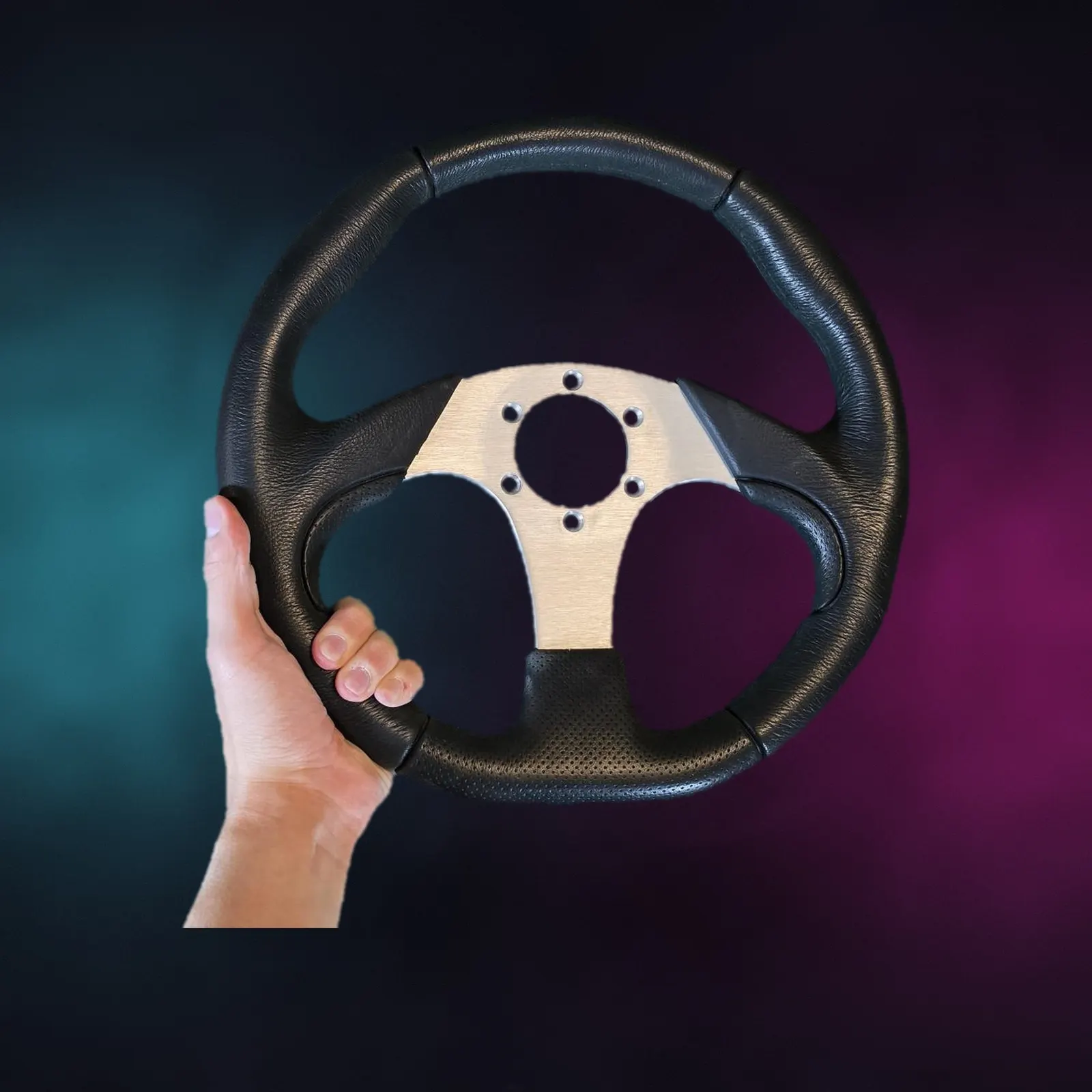
Italian-Made Three-Spoke Steering Wheel — Polished Centre (Brand Unverified)
Measurements
Not measured — ask us.
Canada CA$25.00 per order, free over CA$300.00. Outside Canada CA$40.00.
All sales final. Arrived damaged, wrong or not as described? Tell us within 3 days of delivery. Returns policy.
One of one. When it sells, it moves to the Sold Archive. What the grades mean.
ITALIAN-MADE THREE-SPOKE STEERING WHEEL (POLISHED CENTRE)
Three-spoke steering wheel with a black leather-wrapped rim and a brushed polished alloy centre. The centre plate is machined with a six-bolt fixing circle and drilled lightening holes, and is stamped MADE IN ITALY over the date code 04-08 on the lower spoke. The rim carries a perforated grip section at the base. Documented in honest used condition and graded B.
CONDITION REPORT
- Age-consistent wear; the leather rim is complete with light surface marking and use shine.
- Brushed alloy centre is bright, with dark rub marks and light scoring around the six-bolt circle from previous fitment - clearly visible in the detail photograph.
- MADE IN ITALY and 04-08 stampings are crisp and fully legible.
- Perforated grip section at the base of the rim is intact.
- Six-bolt pattern is intact and unelongated.
- No cracks to the rim, no splits to the leather and no bends visible.
DETAILS
Italy has supplied the aftermarket steering wheel to the world since the 1960s, and the Italian-made wheel became a fixture of Japanese tuning culture in the same way the Recaro seat did - an imported component that signalled intent. This example is unbranded at the centre but stamped MADE IN ITALY with a 04-08 date code on the spoke, the manufacturing convention that lets a wheel of this type be dated precisely where a badge cannot. The rub marks around its bolt circle record a real fitment rather than shelf life. Origin and date are documented from the wheel's own stampings; the maker is not identified on the piece and is therefore not claimed, nor is any vehicle fitment.
The history
The Italian aftermarket steering wheel grew out of racing workshops. Enrico Nardi, born in Bologna in 1907, worked at Lancia from 1929 to 1937 as a truck engineer, racing driver and later adviser to Vincenzo Lancia, and then at Scuderia Ferrari from 1937 to 1946, where he set up the chassis of the Auto Avio Costruzioni 815 in 1940. In 1951, at his own workshop on Via Lancia, he made his first steering wheel, rimmed in walnut; it was first fitted to a 1952 Pegaso. Later Nardi wheels mostly used African mahogany. He died in 1966.
A second generation followed in the 1960s. Gentleman racer Gianpiero Moretti founded MOMO in 1964, the name taken from Moretti and Monza. That year he built a racing wheel for his own car, the first the brand produced, and John Surtees asked for the same wheel for his Formula 1 Ferrari and won a race with it, the first significant victory for the brand. In 1969 MOMO opened a production plant at Tregnago, in the province of Verona.
Both names began in competition. Nardi was a racing driver and chassis engineer before he made wheels, with Mille Miglia entries from 1935 to 1940, and MOMO's first wheel was built for a race car before it went onto a grand prix Ferrari. That link between the circuit and a wheel a road driver could buy is what a MADE IN ITALY stamp on a steering wheel came to suggest, whichever workshop it came from.
This wheel carries no maker's badge, and none is claimed for it. What it does carry is the country stamp and a date code, the marks that let a wheel be placed without a name, and wear around its bolt circle that shows it was fitted and used. As a record it stands for the wider Italian tradition rather than a single brand within it.
Key dates
- 1907Enrico Nardi is born in Bologna.
- 1940Nardi sets up the chassis of the Auto Avio Costruzioni 815 while at Scuderia Ferrari.
- 1951Nardi makes his first steering wheel, rimmed in walnut, at his own workshop.
- 1964Gianpiero Moretti founds MOMO; John Surtees asks for a MOMO wheel for his Formula 1 Ferrari.
- 1969MOMO opens a production plant at Tregnago, province of Verona.
Reading this piece
- The 'MADE IN ITALY' stamp places the wheel in the Italian steering-wheel tradition described here, without identifying a maker.
- The six-bolt centre is the kind of fixing that takes an aftermarket boss adapter rather than bolting straight to a factory column.
- The drilled lightening holes and leather rim follow the competition-derived styling of Italian aftermarket wheels.
Sources (2)
Researched by ZANJPN from the sources above. This history describes the team, brand or event behind the piece; it is not a claim about this particular item's past.