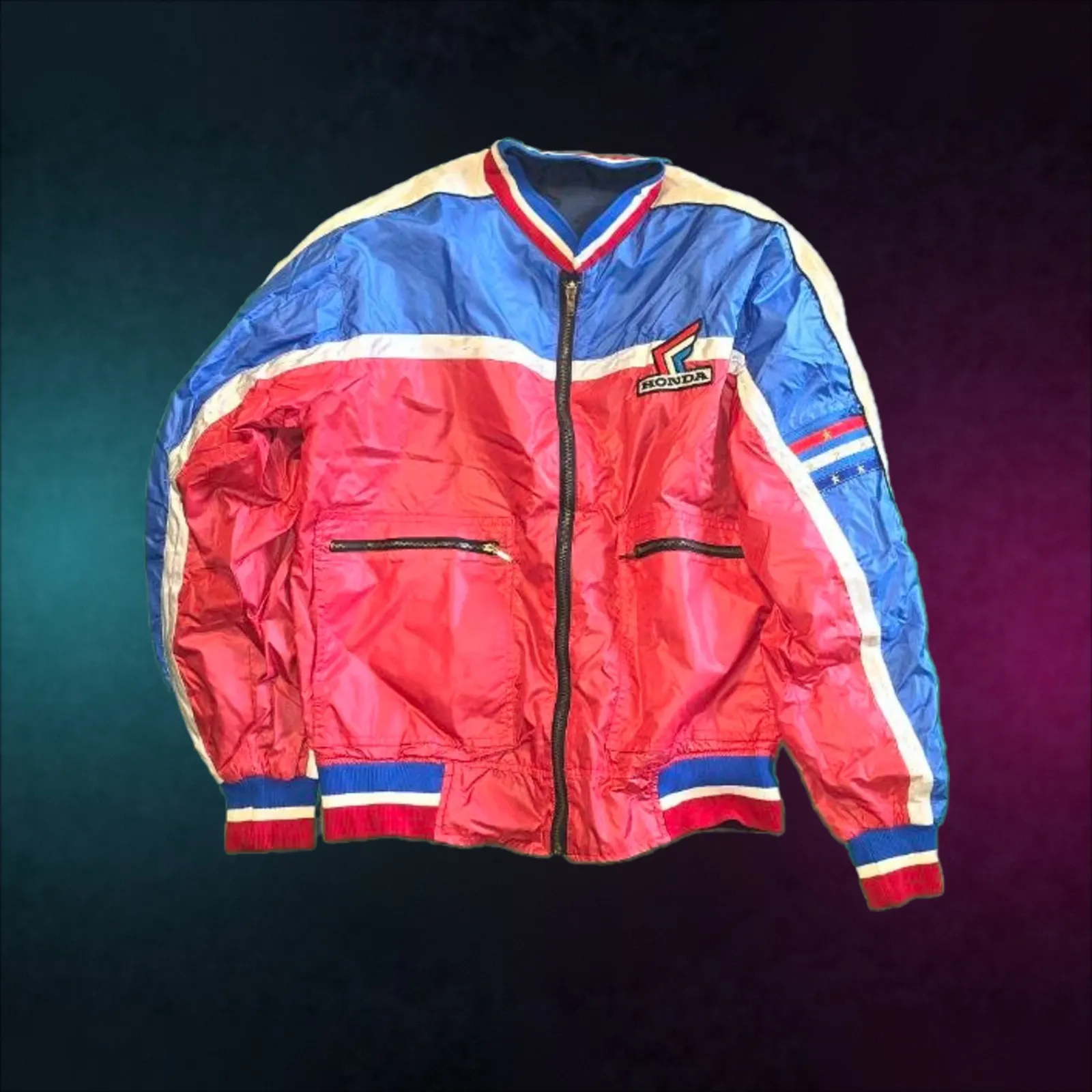
Vintage Honda Tricolour Wing Racing Jacket — 1980s
Measurements
| Measurement | cm | in |
|---|---|---|
| Chest (pit to pit, flat) | 53 | 20.9 |
| Length | 67 | 26.4 |
Measured flat, as stated in the listing. Not measured: sleeve, shoulder. Ask us for any other measurement.
VINTAGE HONDA TRICOLOUR WING RACING JACKET — 1980S
A red, white and blue Honda racing jacket with the 1970s–80s wing logo patch on the chest, an embroidered star-and-stripe sleeve panel, embroidered HONDA across the back and a HONDA monogram lining.
CONDITION REPORT
- Shell is complete and the zip works.
- White stripes show age toning.
- Light marks and creasing consistent with age.
- Lining presents well.
DETAILS
The tricolour wing badge was Honda's motorcycle and racing identity through the 1970s and 80s. How jackets like this one were sold or issued is not verified.
The history
Honda's wing is almost as old as the company. Honda's own history places the first wing on the fuel tank of its earliest auxiliary bicycle engine, and founder Soichiro Honda wanted a mark that suggested flight and a company aiming to be first in the world. The single-wing form that leads to today's mark appeared on the 1955 Dream SA. Under the Honda Engineering Standard introduced in 1960, the feathers were reduced and every element given a set measurement so the mark could be reproduced the same way everywhere, and from 1968 until 2000 the wing served as the official Honda logo on its products.
In 1972 a new wing appeared carrying the word HONDA in place of the old HM initials. It was born on a two-stroke motocross bike that Honda engineers developed and tested in the United States; Soichiro Honda, no fan of two-strokes, approved it on condition that it win, and insisted the machine be recognizable as a Honda. Designers put the name on a wing on the tank. Unlike the earlier mark, this wing took its colours from each model's stripe design, and through the 1980s it spread from off-road machines to the wider motorcycle range. In 1988, Honda's 40th year, the mark was redrawn again after an internal design call drew about 7,800 entries from staff worldwide; it first ran on the NSR500 Grand Prix bike.
The red, white and blue also have a racing story. When Honda first entered Formula 1 in 1964, international racing assigned colours by nation. Soichiro Honda asked for gold and was refused because another country already held it, so Honda raced in ivory with a red disc, Japan's first national racing colours. Honda Racing Corporation, founded in 1982, later added blue to that red and white for its logo, and HRC explains the three as passion for winning, technical ability built on theory, and the fans who love motorsport.
This jacket brings together a wing badge, a red, white and blue colour scheme and the HONDA name across the back, three of the clearest signs of how Honda presented itself to riders. It is worth keeping as a record of that visual language, worn rather than displayed.
Key dates
- 1955The single-wing design that leads to today's wing mark appears on the Dream SA.
- 1964Honda enters Formula 1 in ivory with a red disc, Japan's first national racing colours.
- 1968The wing becomes Honda's official logo on all products, a role it holds until 2000.
- 1972A new wing carrying the HONDA name appears, first on motocross bikes, coloured to suit each model's stripes.
- 1982Honda Racing Corporation is founded; its logo adds blue to Japan's red and white.
- 1988The wing mark is redesigned after a company-wide call for ideas and debuts on the NSR500.
Reading this piece
- The wing patch on the chest is the Honda motorcycle and racing emblem; the listing identifies it as the 1970s-80s style of the mark.
- The red, blue and white shell and ribbed trim use the same three colours HRC later explained as passion, technology and the fans.
- HONDA across the back and in the monogram lining is the word the 1972 wing first brought into the motorcycle mark in place of the HM initials.
Sources (5)
- Wing Mark History 1968 (Honda Global)
- Wing Mark History 1972 (Honda Global)
- Wing Mark History 1988 (Honda Global)
- Wing Mark History 1948 (Honda Global)
- HRC livery design interview (Honda Global, Japanese)
Researched by ZANJPN from the sources above. This history describes the team, brand or event behind the piece; it is not a claim about this particular item's past.
Available now
This one has found a home. These are in stock today.